
LEARNING YOU CAN TRUST

Aquifer AI

Our AI features are thoughtfully developed to create ethical technology that supports teaching and learning.

Advancing Clinical Training with Educator-Guided AI

Aquifer uses AI to solve real challenges in health professions education—not to showcase technology for its own sake. Built on our nationally trusted cases and assessments, our AI extends what great preceptors do best: coach clinical reasoning and communication at scale, with consistency and timeliness.

Every AI feature for students is grounded in peer-reviewed content and guided by our Consortium of practicing clinician educators. As a result, students experience feedback and learning activities that align with sound pedagogy, national curricula, and high standards for patient care. Plus, educators get tools that help them with planning and supporting student learning. 

Patient VPE small

Virtual Patient Encounters

To support communication and information-gathering skills that can’t be learned through multiple-choice questions alone, Aquifer has introduced AI-enabled Virtual Patient Encounters (VPEs) across core clinical cases.

In a VPE, learners conduct a dynamic interview with a simulated patient, deciding how to open the visit, what questions to ask, and how to adapt based on patient responses. The experience mirrors real practice in a safe, low-stakes environment that allows learners to practice and refine their approach.

After each encounter, students receive immediate, personalized feedback mapped to established clinical performance criteria, including history-taking, question focus, and diagnostic reasoning. Student feedback shows high engagement and strong perceived value for building confidence and readiness for real patient encounters.


MrAikenChat v2 (1)

Summary Statement Feedback

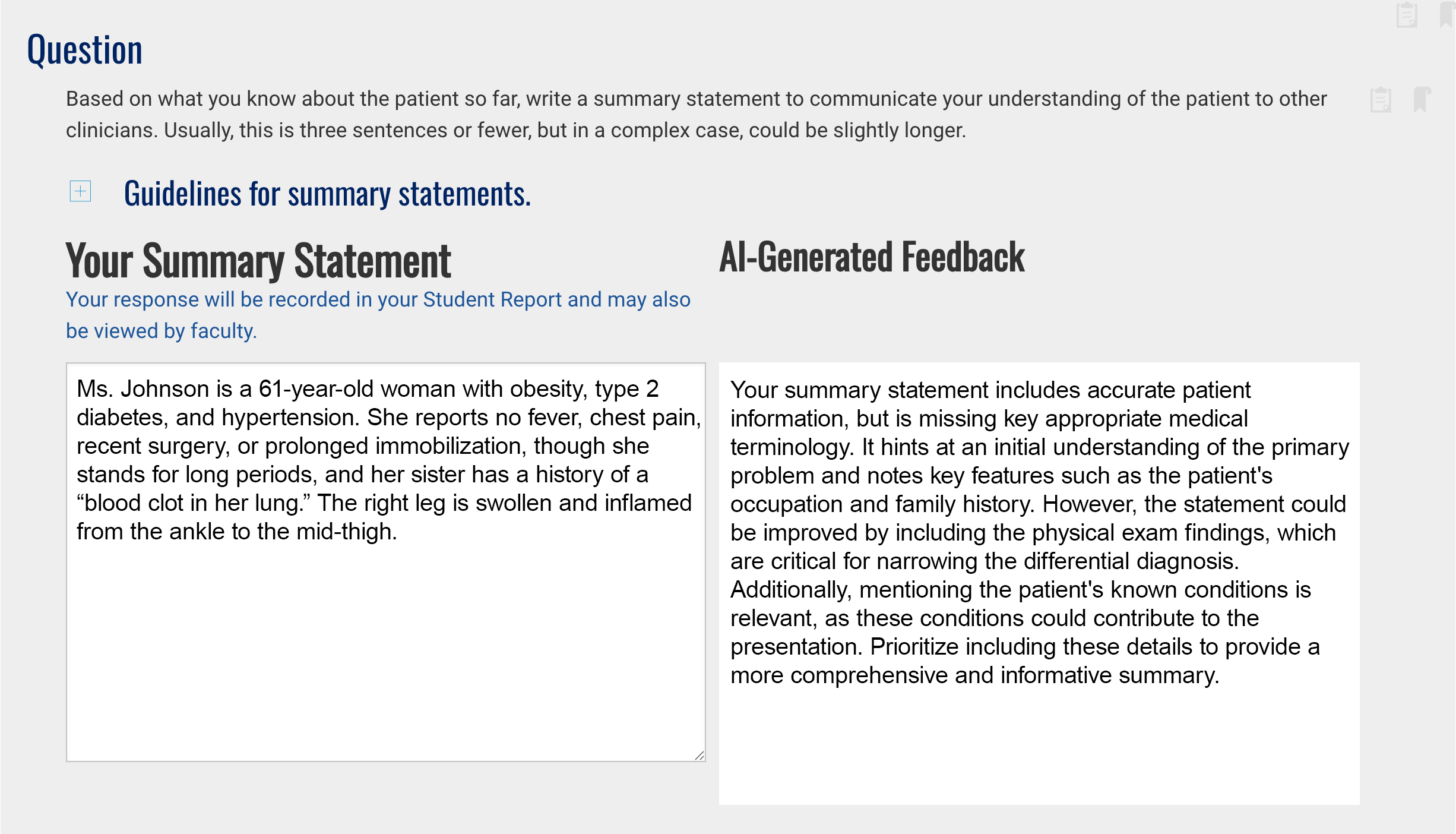
Summary statements offer a clear window into learners’ clinical reasoning, revealing how they synthesize information, prioritize problems, and frame a differential diagnosis. Yet in busy clinical settings, learners often receive little timely or specific feedback on this essential skill.

Within Aquifer’s virtual patient cases, students write a brief summary statement that is immediately analyzed by AI acting as a digital clinical preceptor. In seconds, learners receive structured, actionable feedback—guidance that would typically take an educator 15–20 minutes per case.

This feedback is driven by expert-validated rubrics, comparison to exemplar summaries, and a preceptor-style focus on what matters most clinically. Since launching in 2023, the tool has delivered over a million feedback interactions, with students and educators valuing its clarity, consistency, and alignment with real clinical expectations.
SummaryStatementAIFeedback

AI Assistant

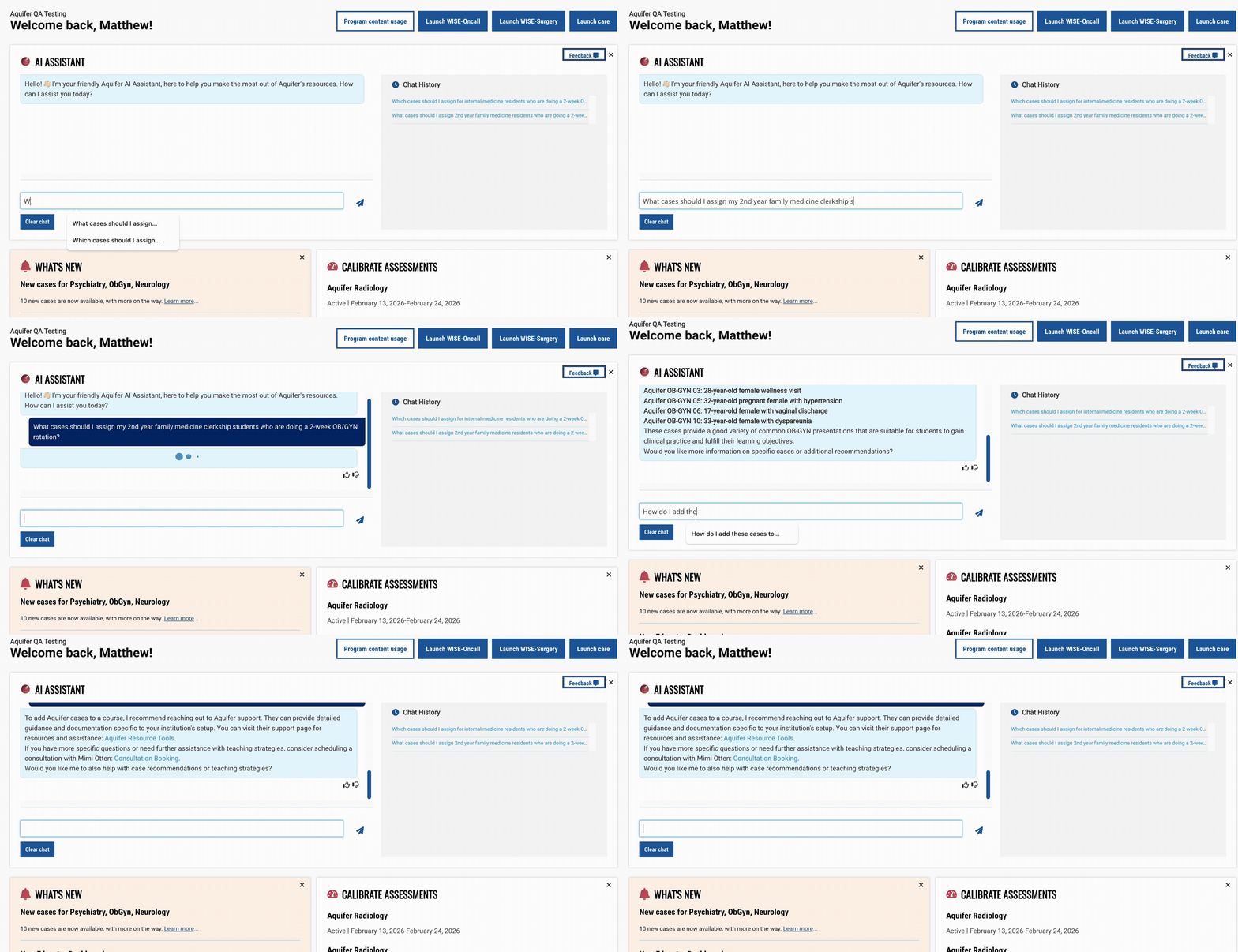
Aquifer’s AI Assistant is an interactive, in-platform chatbot designed to help health professions educators and administrators work more efficiently with Aquifer content. Drawing from trusted case synopses, learning objectives, and Aquifer blogs, the Assistant makes it easy to find relevant cases and scripts. It also provides practical guidance on aligning cases with teaching goals, learner level, and curricular needs.

Built directly into Aqueduct, the AI Assistant supports seamless action as well as discovery. An upcoming enhancement will allow educators to move directly from query results to building custom courses for their students, reducing friction in curriculum planning. With access to published teaching strategies and best practices, the Assistant also helps educators explore new approaches to using cases effectively. As with all Aquifer AI tools, it is grounded in educator-authored content and designed to support thoughtful, efficient curriculum integration.

AI Assistant_1_1

Built by Educators, Powered by AI

What sets Aquifer’s AI apart is not just the technology, but the educational foundation behind it. Every AI-driven feature is grounded in expert-authored cases, published best practices in teaching and assessment, and direct input from interdisciplinary health professions educators.

Educator working groups regularly review AI behavior, refine patient personas, and test feedback with learners to ensure each interaction reflects the guidance of a skilled preceptor. Students are also deeply involved, helping confirm that feedback feels authentic and educationally meaningful.

The result is AI that reinforces—not replaces—high-quality teaching, extending faculty reach while protecting the integrity of institutional educational missions.

2025ConsortiumSmall

Get started with Aquifer today!

Learn more about our institutional subscriptions.