3 min read
Engaging Gen Z Students Around Principles of Geriatrics
Samantha Lau, MD | Assistant Professor, Brookdale Department of Geriatrics and Palliative Medicine | Icahn School of Medicine...
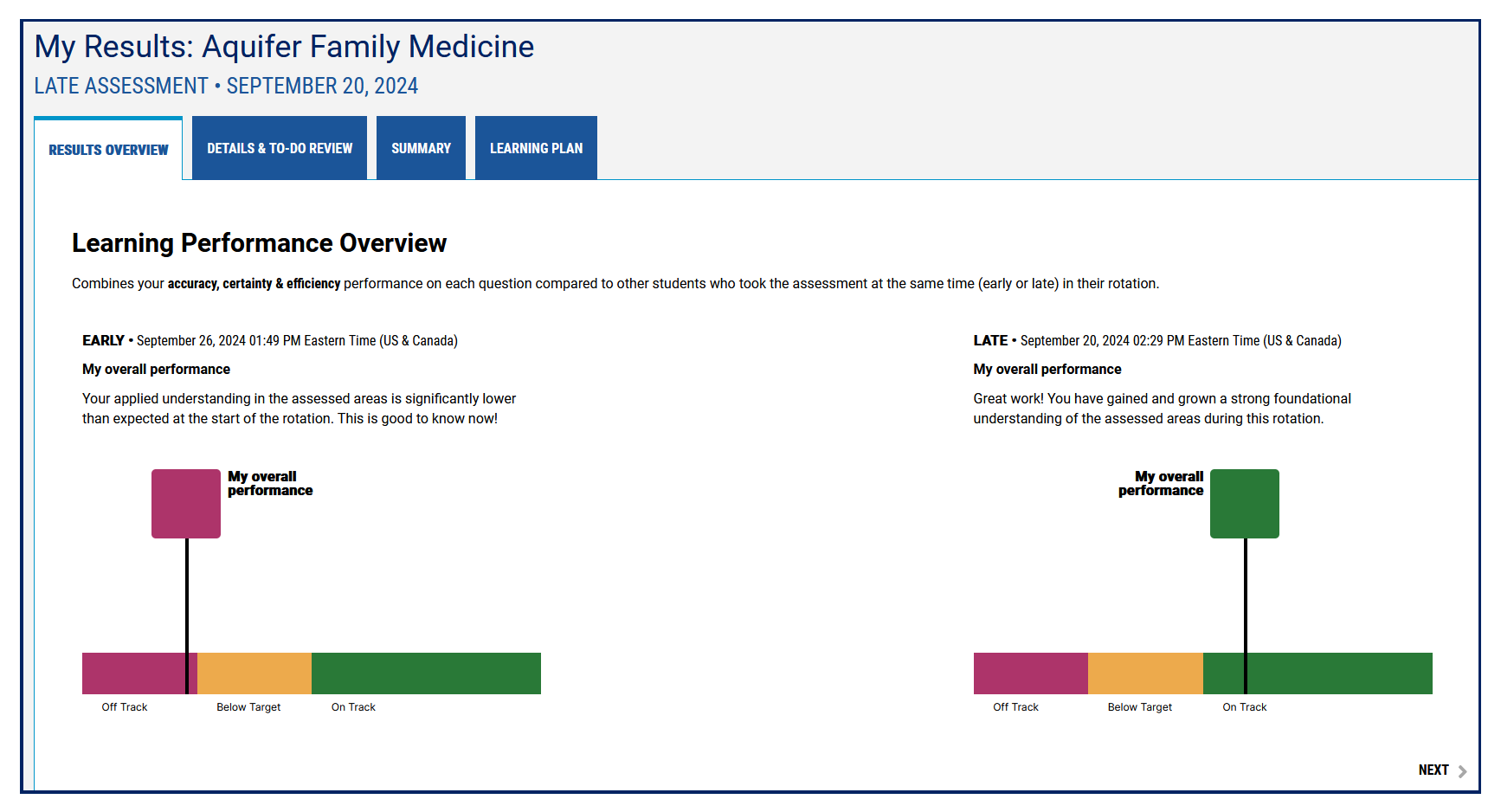
Faculty play a central role in shaping how learners engage with formative assessments. A recent study in Family Medicine (Wingrove et al., 2025) offers compelling evidence that how learners participate in ongoing assessments—particularly those emphasizing reflection and confidence calibration—has a measurable impact on summative exam success.
Even more importantly, tools like Aquifer’s Calibrate bring this research to life, enabling educators to translate theory into practice through structured, data-informed learning.
The Knowledge Self-Assessment Engagement and Family Medicine Board Examination Outcomes study examined more than 24,000 family physicians who participated in the American Board of Family Medicine’s Continuous Knowledge Self-Assessment (CKSA). The findings are clear: consistent, thoughtful engagement in formative assessments directly improves performance on high-stakes certification exams.
This evidence reinforces that how students engage matters as much as how much they study. Intentional, reflective engagement is not an optional habit—it’s a measurable determinant of success.
Calibrate transforms CKSA research insights into an automated, learner-centered assessment experience. By integrating structured reflection, early engagement, and adaptive feedback, Calibrate automatically delivers individualized learning insights—reducing manual grading and feedback demands. This intelligent automation not only reinforces evidence-based learning, but also saves faculty significant time, allowing them to focus on high-impact teaching and mentorship.
| CKSA Research Finding | Calibrate | Faculty Benefit |
| Repeated engagement improves outcomes | Offers early and late assessments that reinforce spaced repetition | Encourages distributed learning over time |
| Metacognition predicts success | Requires a certainty rating for every response, mapping confidence to correctness | Provides data to coach metacognitive accuracy |
| Low-confidence areas drive growth | Identifies low-confidence or incorrect responses and links to Aquifer cases | Streamlines individualized remediation |
| Early participation enhances performance | Early assessment may be delivered early in the clerkship | Prevents cramming and promotes consistent engagement |
| Need to identify at-risk learners | Generates cohort-level analytics showing confidence, accuracy, and trends | Functions as an engagement index to guide early intervention |
The Family Medicine study doesn’t just highlight learner behaviors—it demonstrates how Calibrate streamlines faculty engagement by integrating powerful analytics directly within the Aqueduct learning platform. Educators can save valuable time while enhancing learner outcomes by:
By embedding evidence-based assessment directly into Aqueduct, Calibrate transforms evaluation from a time-consuming endpoint into an ongoing, efficient feedback process—perfectly aligned with the goals of competency-based medical education.
The CKSA study highlights an essential truth: formative assessment is not just about knowledge—it’s about reflection and consistency. Faculty are uniquely positioned to model and reinforce these behaviors.
Calibrate supports this culture shift by making reflection and feedback part of the learning workflow. When learners see their confidence tracked alongside accuracy, they begin to internalize the habit of questioning not only what they know, but how well they know it.
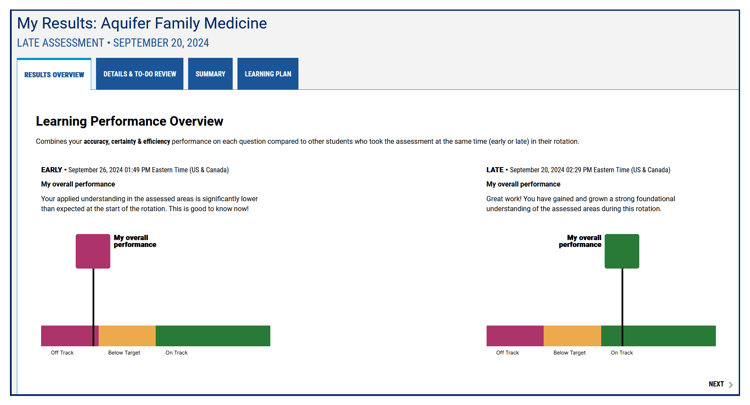
For programs, this means moving beyond one-time assessments toward a system of continuous, data-informed learning—one that aligns with the broader goals of competency-based medical education.
For faculty educators, the convergence of CKSA research and Calibrate’s design offers a rare opportunity: evidence-based affirmation that how we structure formative engagement directly shapes summative outcomes.
By integrating tools like Calibrate, programs can foster lifelong learning behaviors, identify struggling students sooner, and align local education practices with national standards for continuing certification.
Want to explore how Calibrate can help your program identify at-risk learners, foster metacognition, or strengthen assessment strategies?
👉 Request a curricular consult: aquifer.org/curricular-consult

3 min read
Samantha Lau, MD | Assistant Professor, Brookdale Department of Geriatrics and Palliative Medicine | Icahn School of Medicine...
1 min read
Every year, COMSEP gives me a few days to set aside the noise of the broader world and reconnect with a community of dear friends that cares deeply...

2 min read
At the recent AAMC Conference on Emerging Technologies for Teaching and Learning, Aquifer’s Dr. Leslie Fall (CEO and Founder), Joseph...