1 min read
The Hardest Thing to Teach in NP Education—and Why It Matters More Than Ever
Some of the most important skills in nurse practitioner (NP) education are also the hardest to teach.
Artificial Intelligence (AI) can now generate differential diagnoses, summarize evidence, draft narrative assessments, and answer clinical questions in seconds. We, as health professions educators, know that students are using AI tools to assist in these tasks, but are they developing the reasoning to use them well?
At this year's ADMSEP national meeting, educators shared questions that extended well beyond AI tools. How do we prepare learners for a future where medical knowledge evolves faster than ever? How do we help students develop clinical judgment when information is available instantly? And how do we ensure feedback, assessment, and active learning continue to build expertise?
Those conversations spanned nearly every session we attended. Some focused on AI-assisted narrative assessments. Others explored telepsychiatry, active learning, or formative feedback. On the surface, they seemed like separate topics. Looking back, they all pointed toward the same challenge: preparing learners who can continue learning throughout their careers.
This idea came into focus during the keynote speaker Dr. William Cutrer’s presentation.
Dr. Cutrer opened with a sobering reality. Medical literature doubles roughly every 73 days, yet most practicing physicians can spare barely an hour a week to keep up with it. The result is a well-documented 17-year lag between what research establishes and what actually happens in clinical practice.
That gap is the starting point for the Master Adaptive Learner (MAL) model which aims to develop clinicians who know how to recognize knowledge gaps, seek new information, evaluate their performance, and continually improve throughout their careers.
The model itself is a simple, repeating cycle:
Plan — identify a learning gap
Learn — engage in meaningful learning experiences
Assess — seek and interpret feedback
Adjust — apply what you’ve learned and continue improving
It's a framework Aquifer has effectively been building around for years, expressed in our own Clinical Learning System cycle: Plan, Learn, Assess, Analyze (to adjust).
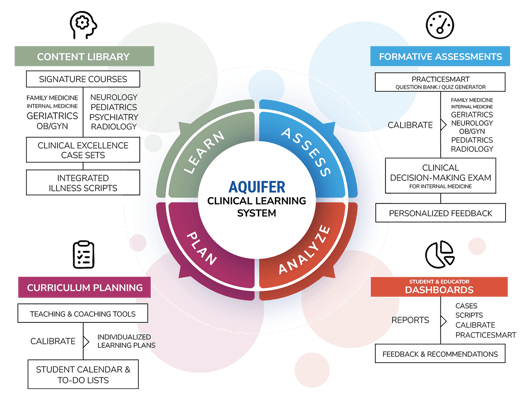
As we reflected on the conference, the impact of AI on this framework reinforces the importance of the MAL approach.
AI is a constant discussion point now, however the focus is often on efficiency. While valuable, most health professions educators also recognized it raises a new educational challenge. Knowing how to question and apply generated answers, know its limitations, and integrate it into patient care becomes critical.
AI hasn’t changed the math—it has raised the stakes. As Cutrer put it:
"Those using AI with an undifferentiated learning base are going to be at a disadvantage."
That reframes the AI conversation happening across health professions education right now. It’s less "should learners use AI" and more "have we built the underlying capacity to use it well." AI can accelerate learning. It cannot replace the judgement that develops through deliberate practice, reflection, and experience.
Nearly every feedback session at ADMSEP converged on the same uncomfortable conclusion: the problem isn't that faculty or students lack the skill to give or receive feedback in isolation. It's that the environment around feedback actively discourages it.
Cutrer reframed who the work actually belongs to:
"Feedback receivers hold the power, not givers. Prepare them accordingly."
That's a real shift from how most programs think about feedback training, which still disproportionately focuses on teaching faculty to deliver better comments. A separate session on formative feedback made a parallel point: students need to be taught to identify their own goals, ask specific questions, and push back on vague feedback, not just wait to receive it.
The Master Adaptive Learner framework reinforces this idea. Assessment isn't the end of learning. It's the bridge to improvement.
Layered on top is a structural problem the keynote named directly: the conditions most likely to push a growth-minded person toward a fixed mindset are evaluative situations, high-effort situations, critical feedback, and watching others succeed—and health professions education hits all four at once. Faculty lack protected time to write meaningful narrative assessments. Students aren't taught to ask for or use feedback well. Generational expectations misalign. And AI has entered as both a possible fix and a new source of anxiety.
None of this closes the MAL loop without deliberate redesign. "Assess" only works if the feedback behind it is trustworthy, timely, and something learners have been taught to use, not something that happens to them if a preceptor has a spare five minutes.
The clearest applause line of the keynote was also its simplest. Dr. Cutrer challenged educators to think beyond memorization, comparing disconnected facts to “a bowl of peanuts” rather than “peanut brittle” where ideas are meaningfully connected.
He went on to share,
Learning that's effortful, contextual, and connected to real decisions is what builds adaptive expertise rather than routine recall."
That distinction feels increasingly important in an AI-enabled world and centers on what "Learn" means inside the MAL cycle. If information retrieval becomes easier, educational experiences must increasingly help learners synthesize information, reason through uncertainty, navigate ambiguity, and apply knowledge in authentic clinical contexts.
Case-based learning, thoughtful discussion, and opportunities for reflection are becoming even more valuable in our evolving world as they provide judgement development AI cannot support independently.
The ADMSEP community remains clear on a centralized goal: developing clinicians who can think critically, recognize uncertainty, seek meaningful feedback, and keep learning after graduation, even as their environment shifts.
The Master Adaptive Learner framework offers a useful way to organize that work. It reminds us that expertise isn't a destination. It's a continuous cycle of planning, learning, assessing, and adjusting.
As we enter the next phase of AI adoption, the most important question we must ask ourselves as program leaders, faculty, or curriculum developers is how are we not only setting up our students for success in standardized assessments, but also in developing the required skills to be an adaptive learner who can navigate a future that is unpredictable and deliver safe and effective patient care.
At Aquifer, that perspective continues to shape how we think about case-based learning, clinical reasoning, and the educational experiences that prepare learners not only for today's practice, but also for the changes still ahead.
Curious how case-based learning and longitudinal feedback data can support a Master Adaptive Learner approach in your curriculum?
Schedule a meeting with our team or explore how Aquifer's cases are designed to keep clinical reasoning—not just recall—at the center of the learning cycle.
1 min read
Some of the most important skills in nurse practitioner (NP) education are also the hardest to teach.
2 min read
At the recent AAMC Conference on Emerging Technologies for Teaching and Learning, Aquifer’s Dr. Leslie Fall (CEO and Founder), Joseph...

1 min read
Managing LCME 7.3 Standards